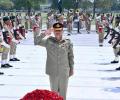
Creating a powerful new chief of defence forces has split the Pakistan military into four competing factions, points out Rana Banerji, who headed the Pakistan desk at RA&W.

'Trump has personally weighed in to overcome doubts and reservations about Pakistan among his top advisors.'
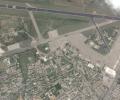
Pakistan's Prime Minister Shehbaz Sharif admitted that India's ballistic missiles hit Nur Khan Airbase and other sites on May 10, a rare acknowledgement that contradicts Pakistan's usual stance of denial when it comes to Indian military action.
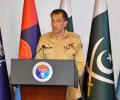
Lt Gen Ahmed Sharif Chaudhry, the spokesperson for the Pakistan Army, is the son of a nuclear scientist who was sanctioned by the United Nations and the US for providing information and expertise to al-Qaeda, according to Indian officials. Chaudhry's father, Sultan Bashiruddin Mahmood, allegedly provided insights into nuclear weapons infrastructure and raised funds for a fundamentalist organization linked to the Taliban. Mahmood was arrested in 2001 after admitting to meeting Osama bin Laden but was later released.

Pakistan Prime Minister Shehbaz Sharif on Thursday chose Lt Gen Asim Munir as the new Army chief to replace incumbent General Qamar Javed Bajwa.
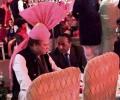
"Wearing the gifted turban of Modi itself shows that Sharif's sincere intention towards the neighbouring country. Besides, it also demonstrates that Sharif values the gift of Modi," a source added.

The military establishment is in no mood to forgive or forget Imran's anti-military utterances, observes Rana Banerji, who headed the Pakistan desk at RAW, India's external intelligence agency.
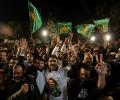
The result is a big blow to the military establishment, revealing the limits of 'political engineering'. It reflected the anger of the electorate, especially its younger voters, who have spoken decisively against the persistent harassment and victimisation of Imran Khan's political party, asserts Rana Banerji, who headed the Pakistan desk at RA&W.

A triumphant Khan returned to his Lahore home on Saturday after having locked himself in the Islamabad high court premises for hours for fear of re-arrest despite being granted bail on Friday.

The police personnel removed barricades from the entrance of the Pakistan Tehreek-e-Insaf (PTI) party chief's residence and removed all camps the PTI activists had erected to protect their leader.

Khan took strong exception to the Inter-Services Public Relations (ISPR) allegations against him and said the spokesperson of the army's military wing was not even born when he represented Pakistan in the world.
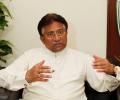
Learning perhaps from the Kargil debacle, Musharraf tried hard to evolve as a statesman in his dealings with India, recalls Rana Banerji, who headed the Pakistan desk at RA&W.

The only thing that might justify a response is the desperate state of Pakistan's economy and how its people are suffering. But it's better to be heartless for now, argues Shekhar Gupta.

His disqualification to participate in future elections may follow, notes Rana Banerji, who headed the Pakistan desk at RA&W, India's external intelligence agency.

The Pakistan Foreign Office gave no reason for Lodhi's removal in a statement late on Monday.
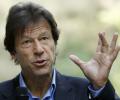
In a major relief for cricketer-turned-politician Imran Khan, Pakistan's Supreme Court today withdrew the contempt of court notice against him. A three-member bench headed by Justice Anwar Zaheer Jamali discharged the notice after hearing the arguments of Attorney General Munir A Malik in the case who said that it is not the matter of disobedience.
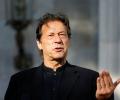
Khan's spokesman Dr Shehbaz Gill said that the prime minister has just a slight fever and cough.
